
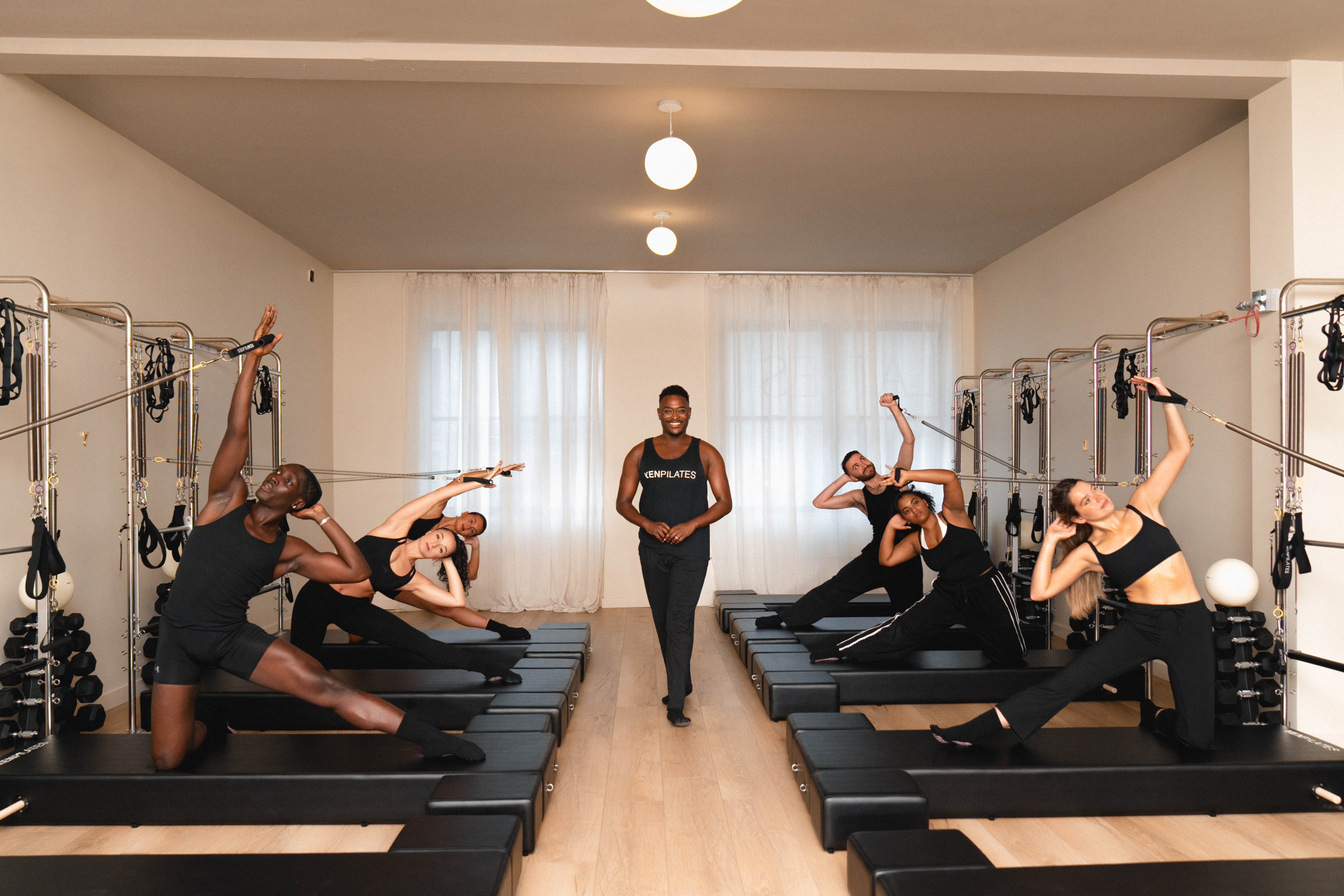
Tower Pilates is a form of Pilates practiced on a tower: a wall-mounted frame of springs, bars, and straps anchored at one end of a fixed mat. Instead of riding a moving carriage, you work against spring resistance while the ground under you holds still, lying down, kneeling, sitting, and standing on the mat. The tower descends from the Cadillac, the largest apparatus in Joseph Pilates' original system, and it trains the whole body at once: strength, control, and mobility in a single continuous practice. If the reformer is the Pilates machine everyone can picture, the tower is the one this guide will make just as clear.
A tower is one end of a Cadillac, taken off its frame and mounted on a wall. Everything you work with hangs on that one upright frame, and every station in a tower room is identical, which is what makes group classes on it possible. The parts are few, and each one has a job.
That is the whole machine. No motor, no screen, no moving platform. A frame, a set of springs, two bars, straps, and a mat, arranged so a teacher can load nearly any movement pattern Pilates has.
The tower's family history starts with Joseph Pilates himself. Interned on the Isle of Man during the First World War, he rigged springs to hospital beds so that injured soldiers who could not yet stand could still move against resistance. Those bed springs grew into his apparatus system after he emigrated to New York, and the most complete expression of it was the Cadillac: a raised mat table inside a four-post frame, fitted with arm springs, leg springs, a roll-down bar, a push-through bar, and a trapeze. Students nicknamed the fully loaded table after the luxury car, the one with everything on it. The Cadillac became, and remains, the gold standard of the private Pilates studio. It also serves exactly one person at a time.
The tower exists because one teacher needed the Cadillac's work to fit a room full of people. In 1976, Romana Kryzanowska, Joseph Pilates' protégée and the teacher who carried his studio after his death, was invited to run Pilates for the dance department at SUNY Purchase, under Dean Bill Bales, where the work became required training for dance majors. A dance department cannot train a class on one trapeze table, so the Cadillac's spring end came off the frame and went up on the wall, in units built by equipment maker Steve Giordano for her program. Power Pilates, the school in Romana's lineage, describes that wall unit as the Cadillac with its springs and components placed at one end, connected to a wall, designed to save space and allow for multiple units. That wall unit is the tower: the Cadillac's working end, rebuilt so a whole room can train at once.
Romana never took credit for it. "I'm not a creator," she said. "I just teach what Uncle Joe taught me." The tower has carried that spirit ever since. It is classical equipment, built for a group.
A tower class starts on the mat. You lie down and do real mat work first, because the mat is the foundation of the whole Pilates system and the tower never asks you to skip it. Then the springs come in. Your teacher sets your springs for each exercise, changing attachments and tensions as the class moves: leg springs for the work on your back, the roll-down bar for articulation, the push-through bar for supported and loaded versions of the classical repertoire, and then standing work, where the springs load you on your feet against ground that holds still.
Two things make the format feel different from other Pilates classes. First, nothing has to be reset between exercises, so a good tower class runs as one continuous piece of work, the sequence building from the mat to standing without stalls. Second, your teacher coaches your setup constantly, because the same exercise can be assisted or resisted depending on the springs, and choosing well is the teaching. Expect to be corrected, adjusted, and occasionally surprised by how much a single spring can change an exercise you thought you knew.
This is the comparison everyone asks about, so here it is plainly. Both machines can do almost everything: you can stand on a reformer, and you can lie down on a tower, because Pilates is one repertoire expressed across all of its apparatus. The real difference is what moves underneath you.
We have a whole essay on this question, because it deserves one: The Tower Is Not an Upright Reformer makes the full argument. The short version belongs here: keep your reformer if you love it. The tower is not a replacement. It is a different system, with a different training effect, and the two make each other better.
The tower does not move you. It answers you. Every spring gives back exactly the effort you put in.
Strength. Springs are progressive resistance. As you get stronger, the teacher changes the spring, the leverage, or the exercise, and the load grows with you. Standing tower work loads the legs, glutes, and back the way standing training should, on solid ground, and the classical repertoire was always strength work: Joseph Pilates defined his method around a uniformly developed body, not around stretching.
Control and coordination. Because a spring can help or hinder, tower work teaches you to organize movement rather than just produce it. Reviews of Pilates training consistently find improvements in muscular endurance, flexibility, and balance, and tower practice trains all three in the same session, often in the same exercise.
Mobility with support. The roll-down series and the spring-assisted stretches let stiff bodies move through ranges they cannot yet reach alone, with the springs carrying part of the load while the range grows.
Now the honest part, because a guide should tell you what the evidence does not say. No clinical trial has ever tested the tower itself, so anyone promising tower-specific results is guessing. The research that exists is on Pilates as a whole. A Cochrane review of Pilates for chronic low back pain found it probably reduces pain and disability compared with doing little or nothing, while noting it has not been proven better than other forms of exercise. Research has not shown that Pilates builds bone density, and springs do not detox anything. What the tower offers is simpler and stronger: a complete, loadable, low-impact strength practice with a century of teaching behind it.
Tower Pilates is for anyone who wants strength training that is coached, controlled, and kind to the joints: people who love mat Pilates and want it loaded, reformer loyalists who want a second system, athletes and dancers cross-training, and complete beginners, because the springs can assist while you learn. If you have never taken a tower class, arrive early and let your teacher walk you around the equipment before class starts, so the springs, bars, and straps feel familiar before the work begins.
A few people should start somewhere else first. If you are working through an injury or returning from surgery, begin with a private session and check with your clinician, so the work is built around your body before you join a group. If what you want most is heat and sweat, start in a heated room and meet the tower on your strength days. And if you simply love the glide of a carriage, the tower will feel foreign for a class or two. Give it three. The stillness grows on people.
We built our Chelsea flagship around this equipment. Ken Pilates Chelsea, at 541 6th Ave, Floor 4 in New York, has two rooms: a heated room, up to 105 degrees, for Hot Mat Sculpt, and the Tower Room, a wall of 15 tower stations where the method below runs every day. You can read the full room breakdown on our Tower Pilates in Chelsea page.
SpringSculpt is our signature tower class. It starts from the classical foundation, the principles and repertoire taught on this equipment for a century, and layers sculpt on top of it: bigger ranges, heavier loads, strength work folded into the classical exercises until the two are the same rep. SpringSculpt is continuous, which means the sequence never stalls. It does not mean fast. The work builds from the first minute to the last, and it is coached rep by rep.
Sculpt & Strength aims the same towers at strength training directly, with Full Body, Upper Body, and Lower Body focus days across the week. Because a tower station opens onto solid floor, the dumbbells come out for heavy standing work, and then the springs come back in for the controlled reps that keep technique clean. Low impact has never meant low load here.
In Hoboken, at 706 Washington Street, SpringSculpt lives on the springboard, a wall-mounted board that is the tower's close cousin. Same spring language, different spring: it is where our method was built, and the two rooms still teach each other. Whichever city you start in, you will be greeted by name by your second visit. Community is the method at Ken Pilates, and the tower room is where you will feel it fastest. Grip socks are required for tower classes, so bring a pair or pick ours up at the studio.
No. You can stand on a reformer and lie down on a tower, so posture is not the difference. The difference is what moves: a reformer works on a gliding carriage, while a tower works over a fixed mat, with you doing the moving against wall-mounted springs.
A tower is the Cadillac's spring end, the springs, roll-down bar, push-through bar, and straps, mounted on a wall over a mat. The Cadillac keeps its four-post frame and trapeze, which allows hanging work a tower cannot do. The tower trades the trapeze for a room: many stations, one class, everyone training together.
Yes. The springs can assist an exercise while you learn it, which makes the tower one of the most beginner-friendly ways into loaded Pilates. Arrive early for your first class so your teacher can familiarize you with the equipment before the sequence starts.
Yes. Spring resistance is progressive resistance, standing work loads the whole body on solid ground, and formats like Sculpt & Strength add dumbbells to the spring work. It is low impact, because nothing pounds your joints, but low impact has never meant low load.
At Ken Pilates Chelsea, 541 6th Ave, Floor 4, New York, NY 10011, where the Tower Room holds 15 stations. A single class is $47, and new clients start with 3 classes for $60.
If you have read this far, you already know more about the tower than most people who walk past our Tower Room door. The next step is to feel a spring answer you. New clients start with our intro offer, 3 classes for $60. Spend one of the three on the tower. A single drop-in class is $47, and the Chelsea schedule has tower classes every day.
I am a trained dancer, and the tower is where my two worlds meet: the discipline of classical Pilates and the way dancers train, standing, loaded, and moving the whole time. Come stand at the wall with us.
- Kennyth
Founder, Ken Pilates


