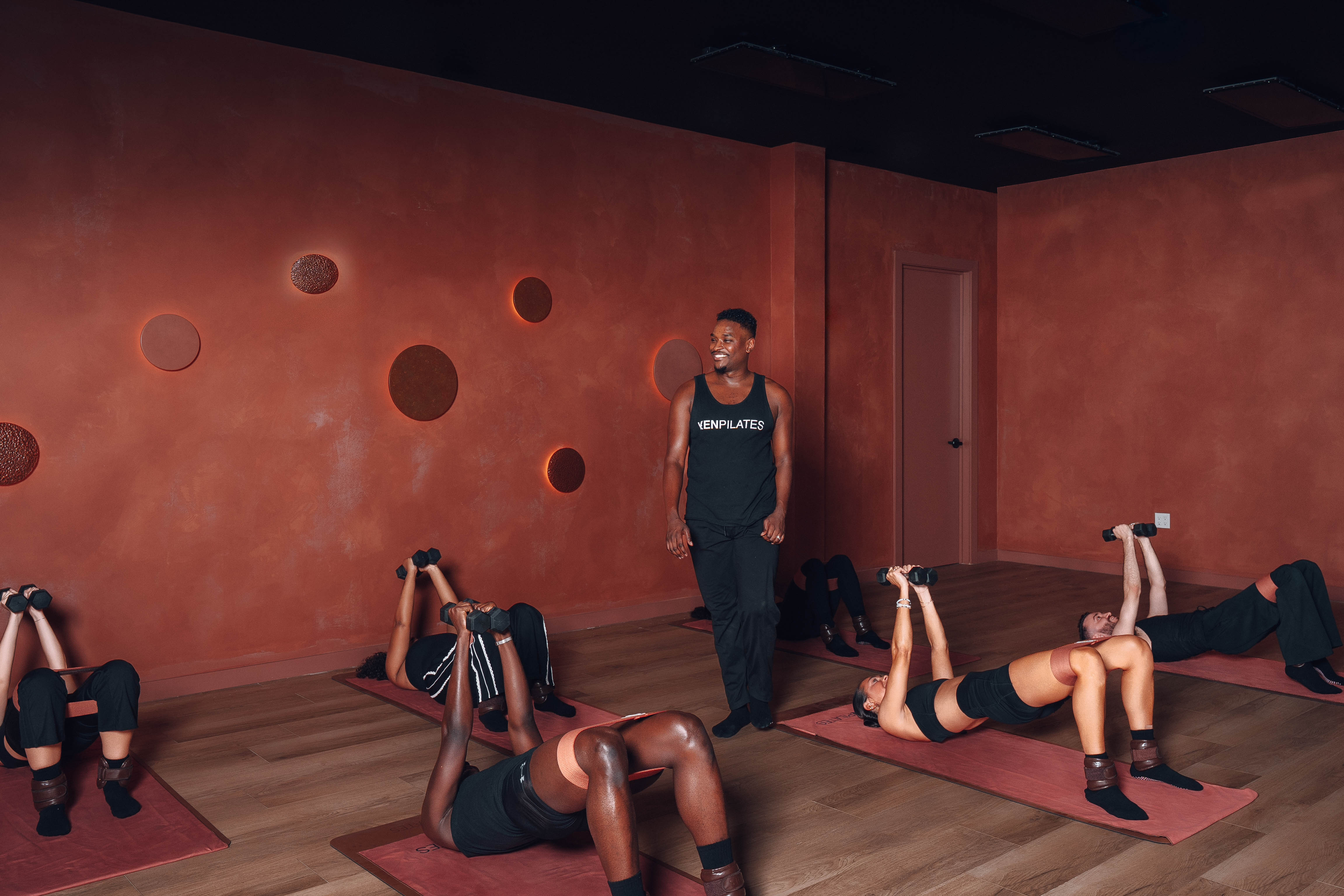
Almost every week, someone walks into our Chelsea studio for a hot class, looks through the doorway into the second room, and asks some version of the same question: "What is that? Is it an upright reformer?"
I get it. The reformer is the machine everybody knows. The tower is the one nobody can picture. Read the word "tower" on a schedule and nothing comes to mind, so people reach for the closest comparison they have. The comparison is honest. It is also wrong in the one way that matters most.
Here is the part most explanations skip. You can stand up on a reformer; people do it all the time. And you can absolutely lie down on a tower. The tower table is a mat, and our tower classes use it that way. Standing versus lying down is not the line between these two systems, because both systems cross it.
There is a reason both machines cross it, and it is the first thing a classical teacher learns: Pilates is one repertoire, not a pile of machine tricks. The same exercises live on every apparatus. Take teaser. On the mat, teaser is you and gravity, with nothing to hold and nowhere to hide. On the reformer, it is the same shape built on a box, with straps feeding spring tension into your hands. On the chair, the same roll-up happens from a seat. And on the tower, the same teaser again, this time under the push-through bar, with its springs ready to support the lift or load it.
The exercise does not change when the equipment does. What changes is the expression: how much the springs help, how much they resist, and how much stability your own body has to supply. One repertoire, expressed on different equipment. That is the system working the way it was designed to work.
But not everything travels, and the other half of the system matters just as much. Each apparatus also holds repertoire that belongs to it alone: exercises Joseph Pilates designed for that specific machine, as he intended that machine to be used, and work that teachers have kept building on each apparatus in contemporary practice ever since. The hanging work lives on the Cadillac because only the Cadillac has the trapeze. The tower's standing spring work lives on the tower because only the tower loads you against ground that holds still. Swan travels. Teaser travels. The vocabulary runs through the whole system. Each machine still keeps pages of the book that no other machine has.
The line is what moves underneath you while you work.
On a reformer, everything happens on a carriage that glides back and forth. Stand on it, and you are standing on a moving surface. That instability is the challenge, and for standing work it is also the risk: the floor itself can slide out from under the exercise.
The tower works the other way. Tower Pilates is a full-body strength practice built on a wall-mounted spring tower, where loaded springs create resistance you push, pull, and stand against. The mat is fixed to the tower table. It does not glide, drift, or roll. When you stand up in a tower class, the ground holds still and you do the moving.
On the reformer, the machine moves. On the tower, you move.
That one difference changes the whole class. Because the surface is stable, standing work can be loaded heavier and taught at full athletic intensity. Because nothing has to be reset between exercises, transitions get smoother and the class can run as one continuous piece of work. The springs change, your position changes, the effort does not stop.
If the tower looks unfamiliar, its family is not. The tower descends from the Cadillac, the trapeze table Joseph Pilates built as the most complete apparatus in his system: a raised mat table inside a four-post frame, loaded with arm springs, leg springs, a roll-down bar, a push-through bar, and a trapeze for hanging work. The Cadillac grew out of springs Pilates rigged to hospital beds, and students nicknamed the fully loaded table after the luxury car. It remains the gold standard of the private studio.
The tower takes the working end of that machine and puts it on the wall. Same springs. Same roll-down bar. Same push-through bar. The roll-down series, the leg-spring work, the assisted stretches: the Cadillac repertoire, kept. Towers are also built as wall units and, in half Cadillac form, mounted on the end of a reformer; ours are wall-mounted, working over a fixed mat. What the tower leaves behind is the canopy and the trapeze. There is no hanging and no inversion on a tower, and the raised table gives way to a mat.
That trade is the whole point for a group room. A Cadillac serves one body at a time. A wall of towers serves a class, every guest on the same fixed ground, every station running the same spring system. The tower is not a smaller Cadillac. It is the Cadillac's spring end, rebuilt for a room full of people moving together.
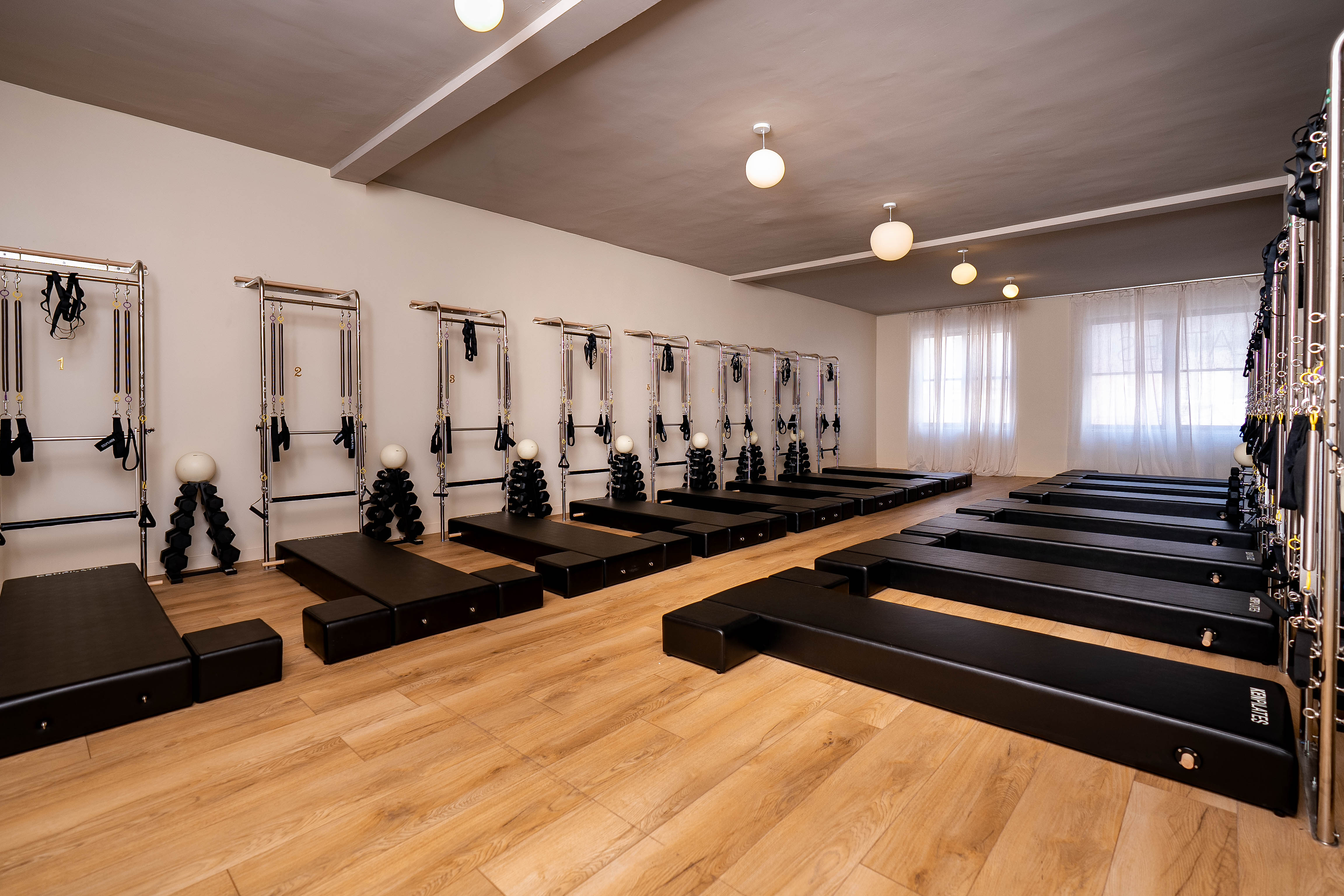
The tower table is a mat, and tower classes start the way mat classes start: on your back, on your side, doing real mat work. Lying down is not a detour from tower training. It is the foundation of it.
Then the springs come in. The wall-mounted springs attach resistance to the mat work you already know, and then they take you up to standing, where the same resistance trains you on your feet. Mat work first, then springs. If you love mat Pilates, nothing about the tower asks you to give it up. It asks you to load it.
At Ken Pilates Chelsea, the Tower Room is a strength room. It is capped at 15 guests, and every class is coached rep by rep. SpringSculpt is our signature tower class: continuous from the first minute to the last, with the sequence building as it goes. Continuous does not mean rushed. It means the work never stalls.
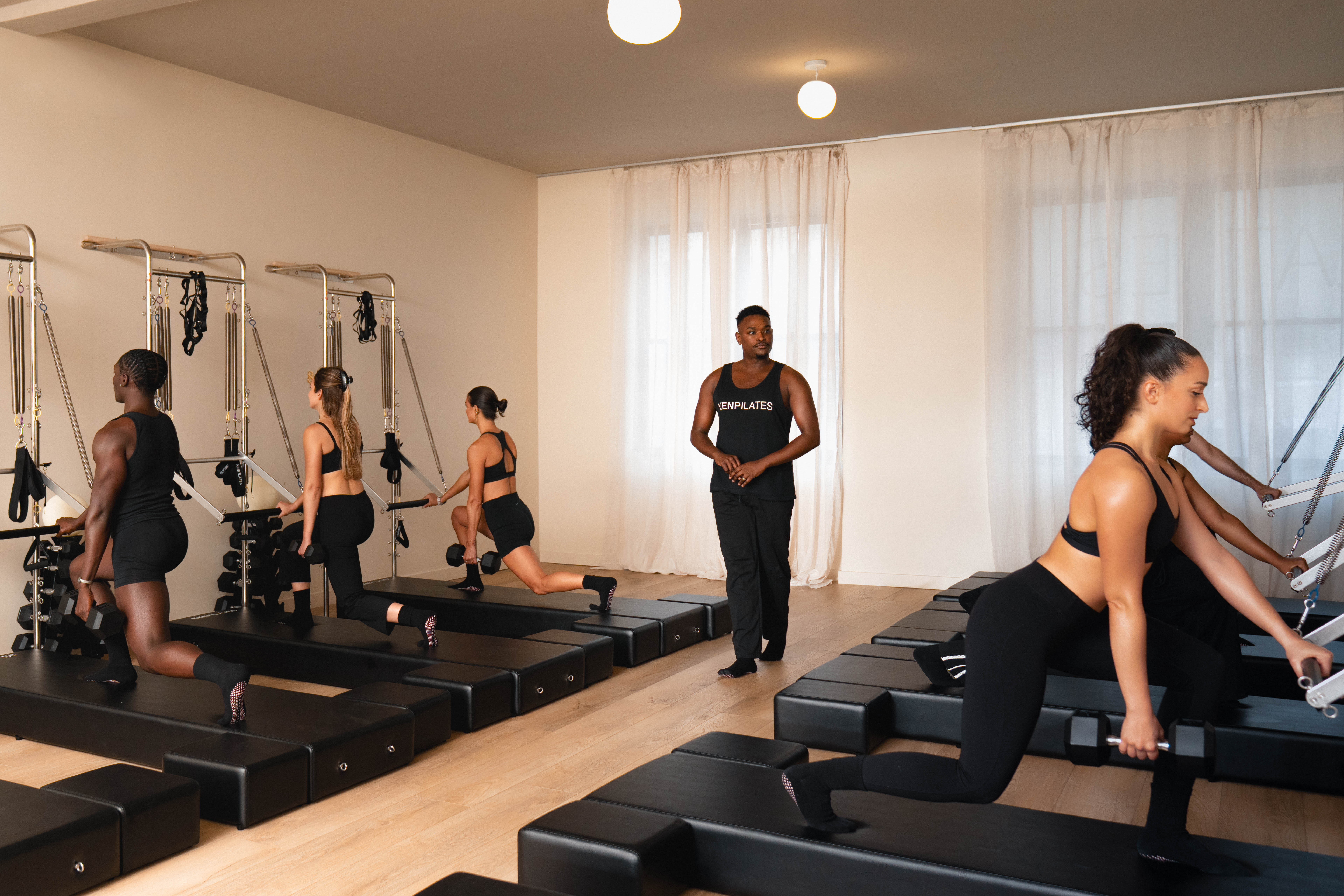
Here is how the method is built. The foundation is Pilates itself: the principles of breath, control, precision, and flow, and the classical exercises that have been taught on this equipment for a century. We did not replace that foundation. We layered on top of it. The layer is sculpt: bigger ranges, heavier loads, strength work folded into the repertoire until the classical exercise and the training stimulus are the same rep. That layering is the Ken Pilates method, and it is why the class is called SpringSculpt.
Sculpt & Strength takes the same tower and aims it, with Full Body, Upper Body, and Lower Body focus days across the week. There is a practical reason the strength classes live on the tower: a tower station opens onto the floor. The mat is fixed and the ground around it is solid, so the dumbbells come out and heavy lifting happens safely, on your feet, with nothing sliding underneath you. Then the springs come right back in for the form work, the controlled, loaded reps that keep technique clean. Low impact has never meant low load here. The tower is a piece of strength equipment that speaks Pilates: springs in one hand, dumbbells in the other, and more exercises available than either tool gives you alone.
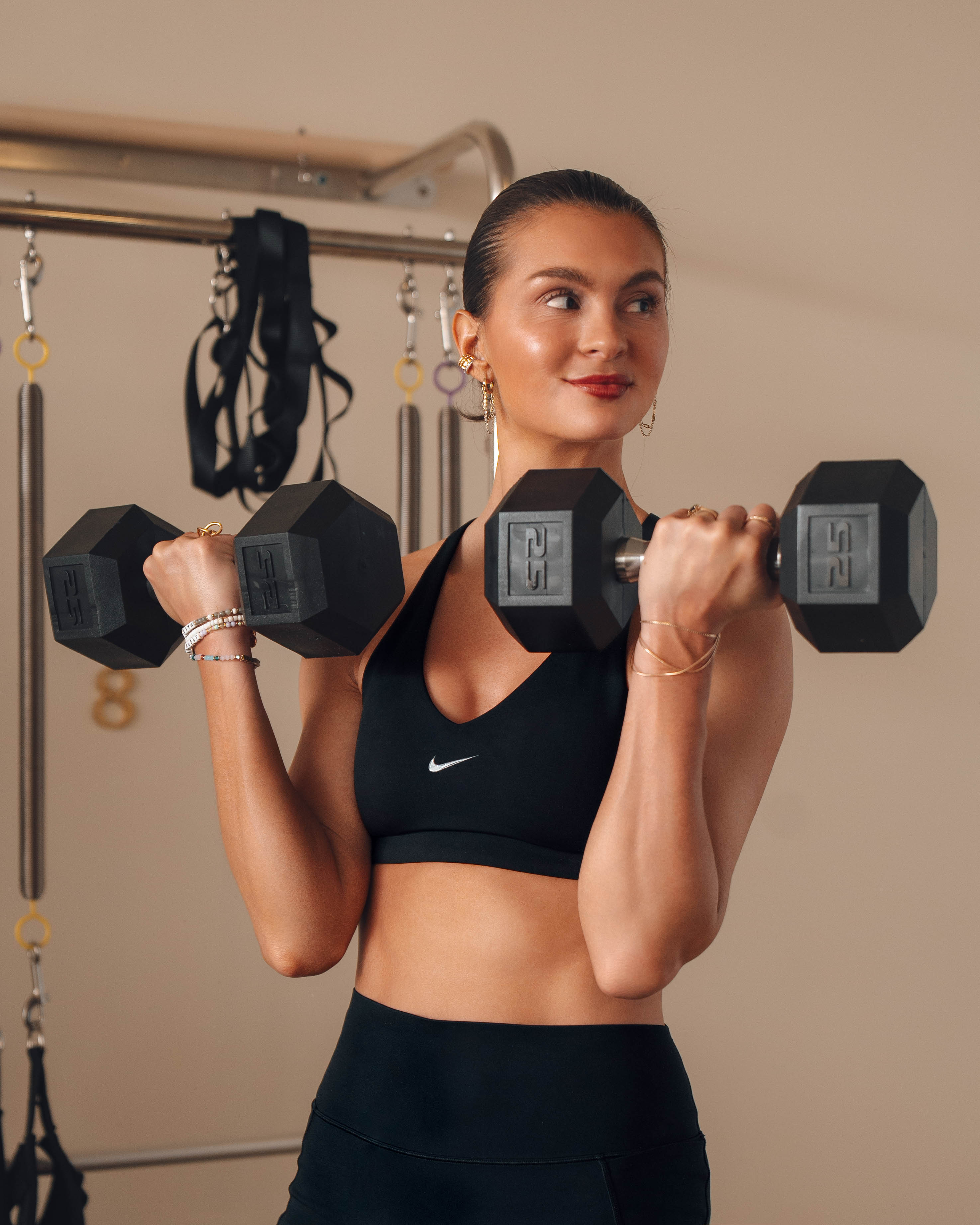
I am a trained dancer, and I built this room the way dancers train: standing, loaded, and moving the whole time. If it is your first tower class, arrive early. We will walk you around the equipment before class starts, so the springs, the push-through bar, and the mat feel familiar before the work begins.
It depends on what you already love.
Our heated room runs up to 105 degrees, and if that room is your home, the tower is your second room, not a departure. The mat work will feel familiar from the first class. The springs will not. Tower Room classes are not heated, so this is also where you come on the days you want the strength without the heat.
Keep your reformer. The tower is not a replacement and it is not trying to be one. It is a different system with a different training effect: a fixed surface, standing load, and springs that meet you where you stand. Plenty of reformer devotees train on the tower precisely because it asks questions a carriage cannot.
Then you are looking for the Tower Room. Sculpt at Ken Pilates lives here, in SpringSculpt and Sculpt & Strength: mat work plus spring resistance, at full intensity, in a room that stays at a normal temperature.
Tower Pilates has sat in the corner of the industry for a long time, treated like an accessory to the reformer. We do not see it that way. We built our Chelsea flagship at 541 6th Ave, Floor 4, with the Tower Room as one of its two centers, because the tower is the most athletic tool in Pilates and this city has barely met it. Ken Pilates is popularizing the tower and making it athletic, one full room at a time.
And the tower is one stop in a much bigger system. If you think you've done all of Pilates, you haven't, because you haven't tapped into all the equipment. Each apparatus holds work that belongs to it alone, and the full spectrum of what Pilates is, and where it can go, only opens inside a comprehensive practice: every apparatus explored properly, the way the system was built to be explored. That is the practice we believe in, and the tower is where it starts.
Come see it the way our hot class guests do: in person. Start with the intro offer, 3 classes for $60, and spend one of the three in the Tower Room. A single drop-in class is $47. Read more about how tower training works, or go straight to the schedule and pick your first tower class.
- Kennyth
Founder, Ken Pilates