
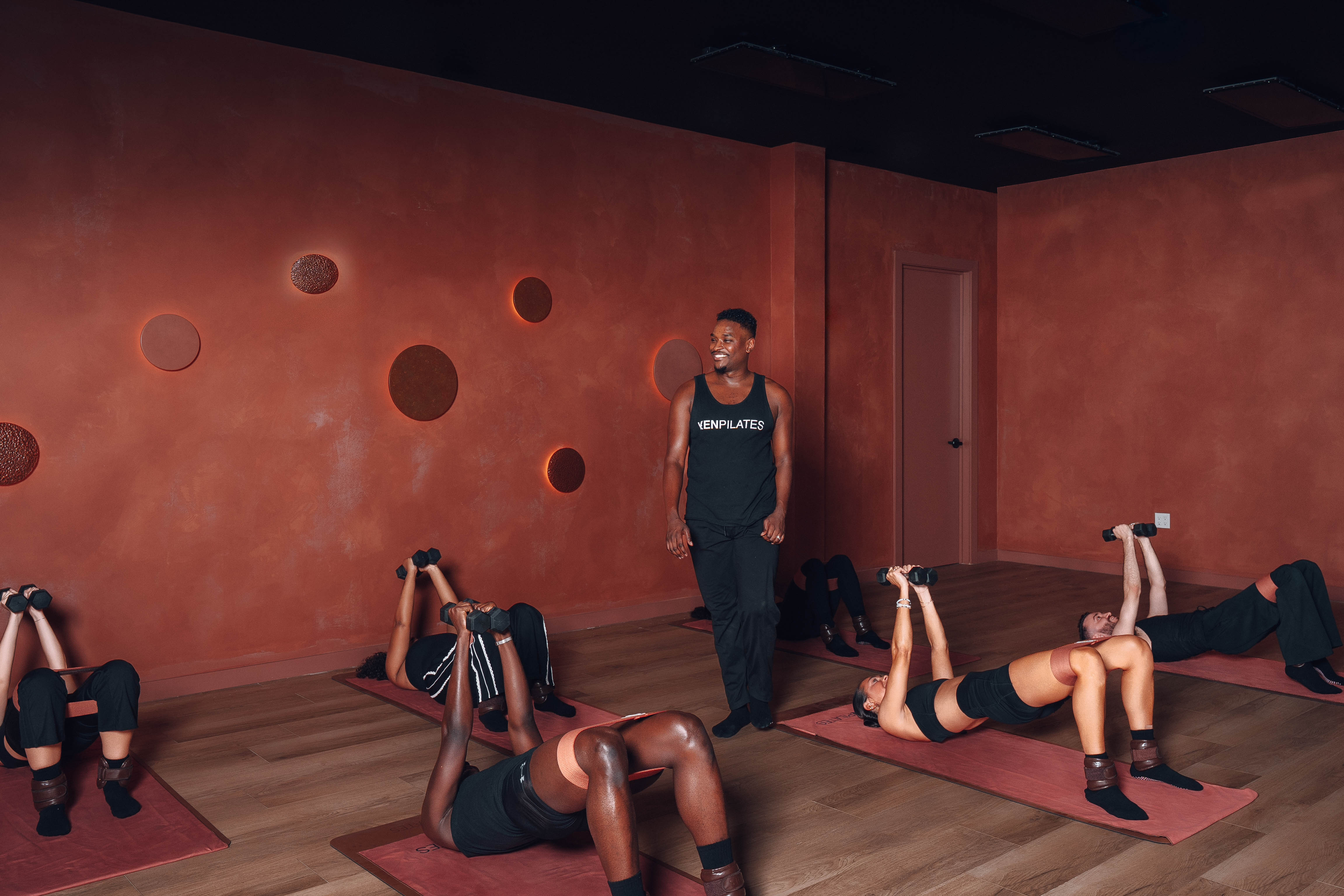
Hot Pilates is mat Pilates taught in a heated room. The work is built on the classical mat repertoire: the hundred, the roll-up, the series of five, leg circles, spine stretch, teaser. The room is what changes. Heat up to 105 degrees, delivered by infrared panels, turns a practice built on control into one that also asks for stamina, focus, and sweat management from the first minute to the last.
That is the whole idea. Nothing about the exercises is watered down for the heat, and nothing about the heat is decoration. The mat work is the discipline. The heat is the load you carry while you do it.
A hot Pilates room is heated with infrared panels rather than blown hot air. Infrared warms the body and the surfaces in the room, so the heat feels even from wall to wall and the air stays breathable while you work. At Ken Pilates Chelsea, the heated room runs up to 105 degrees and holds 20 guests. The lights are low, the mats are laid out before you arrive, and the room is already warm when you walk in, because the warm-up starts the moment your body registers the temperature.
Heat changes three things about a mat class:
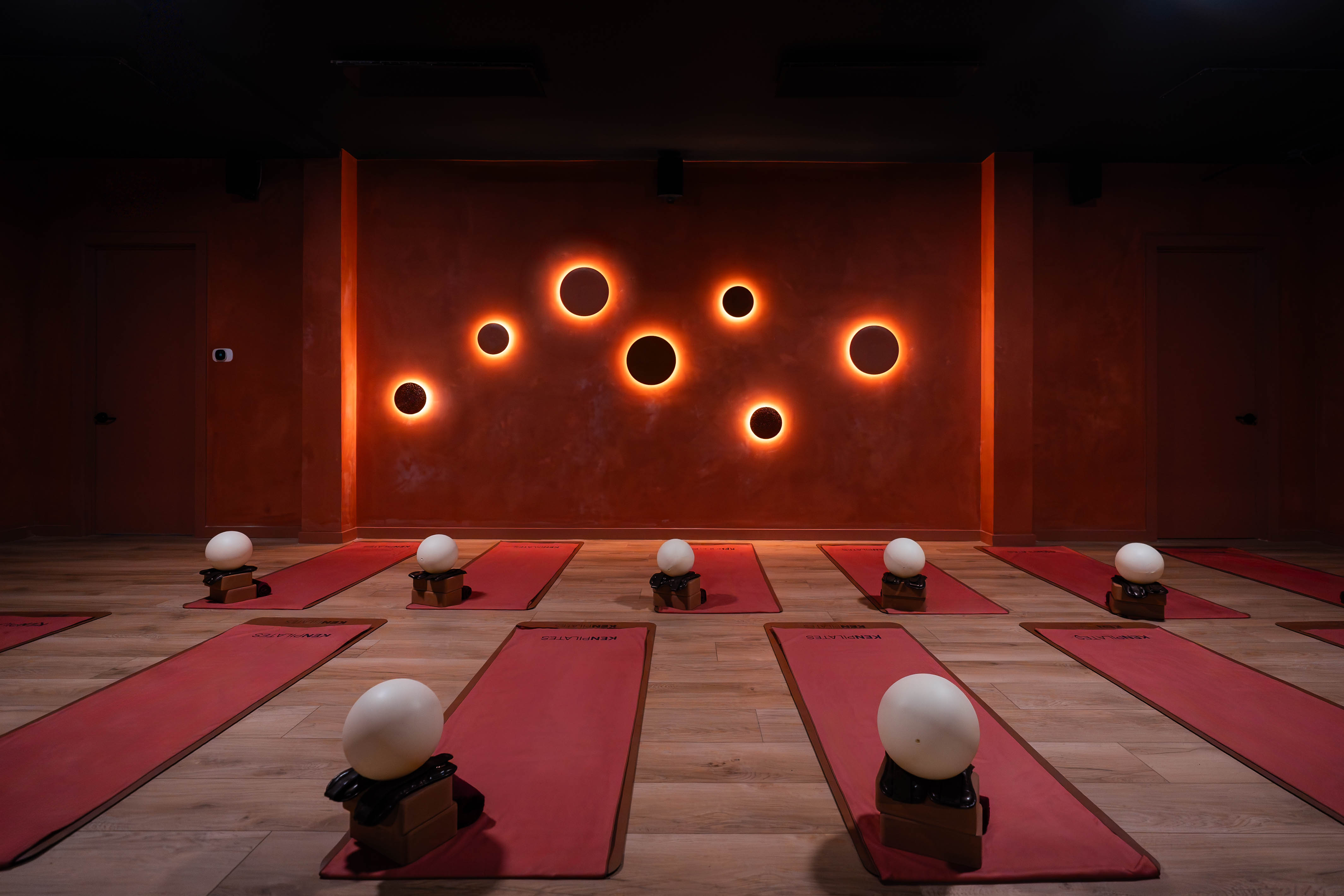
A hot class at Ken Pilates starts low: on the mat, on your back, breathing, finding your center. From there the repertoire builds exercise by exercise, with the heat rising in the background of everything. And this is a training room. Aside from Hot Mat Restore, the recovery class, everything in the hot room is work.
At Ken Pilates, the heated room runs three formats:
Hot Mat Sculpt is the signature. Mat Pilates sequenced for strength, with light weights and props layered into the repertoire, taught at a pace that keeps the room moving. This is the class most people mean when they say hot Pilates in New York right now.
Hot Mat Pilates is the mat repertoire itself, taught in the heat without the sculpt layering. The transitions, the discipline, at full temperature. Do not expect squats and lunges. This is not sculpt. It is Pilates.
Hot Mat Restore is the same room at a gentler setting, about 95 degrees. Long holds, deep stretching, breath-led pacing. It is the recovery end of the heated practice, built for the days between hard ones.
Every class is 50 minutes. You will sweat through your clothes. Bring water, and plan on drinking more of it than you think.
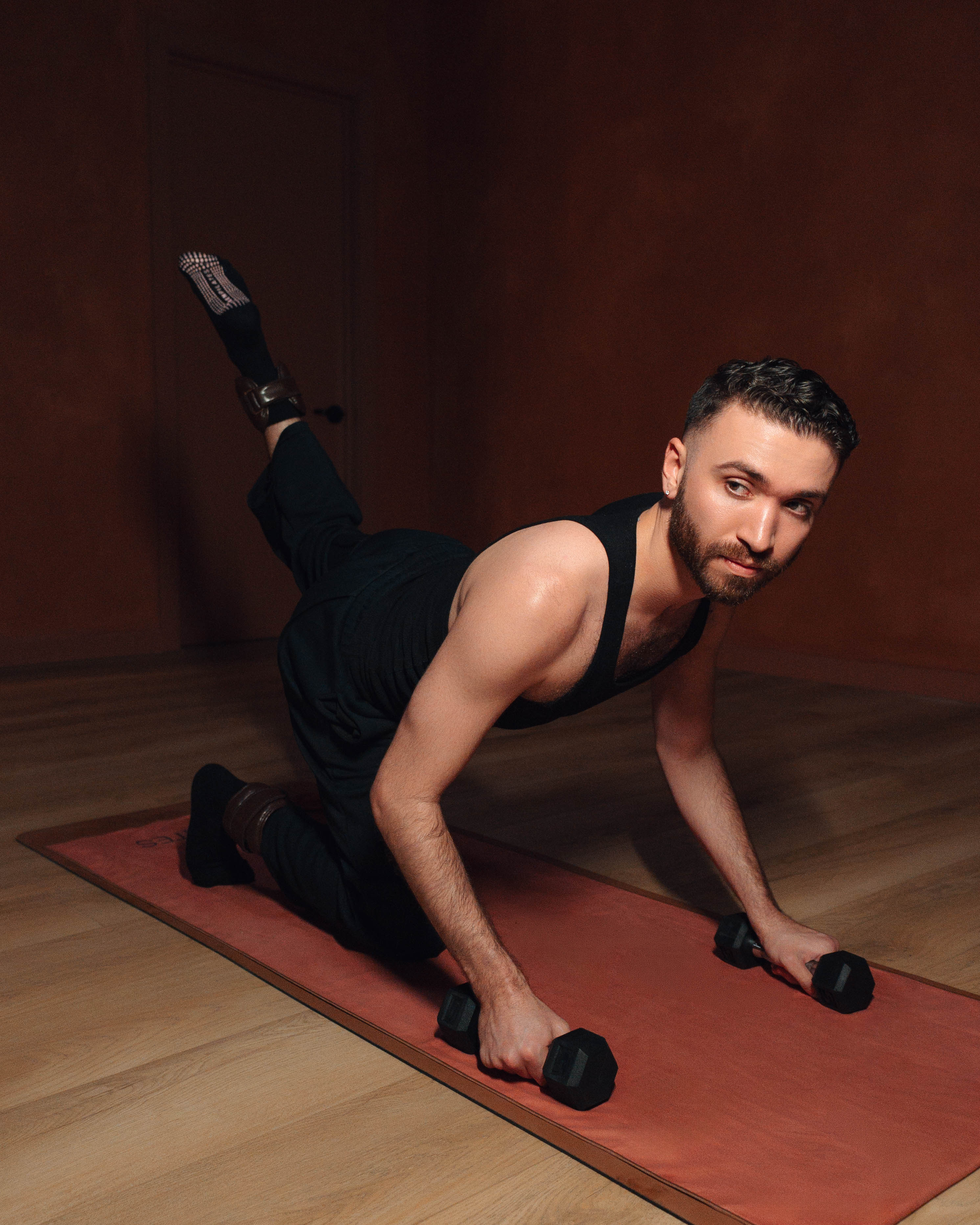
The repertoire is the same. The difference is the environment the repertoire happens in, and environment is not a small thing in training. Heat raises the cardiovascular cost of every exercise, loosens tissue earlier in the session, and adds a mental demand that a cool room does not. A regular mat class asks how precisely you can move. A hot mat class asks how precisely you can move while your body is busy doing something else.
Neither is better. They train different qualities, and the strongest weekly rhythm usually includes both kinds of rooms: heated work for stamina and sweat, tower or cool mat work for loaded strength and precision.
The two share a warm room and nothing else. Yoga is its own discipline, with its own poses, sequencing, and philosophy. Hot Pilates is Pilates: the mat repertoire, taught with Pilates' goals, which are strength, control, uniform development, and a spine that moves the way it was built to. If a class is flowing through yoga poses, it is a yoga class that happens to be hot. If it is working through the mat order, it is Pilates, and the heat is the condition, not the content.
Ken Pilates is not a classical studio, and the hot room is where that is easiest to feel. We do not teach the repertoire exactly the way Joseph Pilates taught it. The classical work is the root and we honor it, but the goal was never to recreate a class from another era. The goal is connection: the body to the self, and the people in the room to the people who came before them. Everything Kennyth teaches was poured into him by his mentors, and he pours it into the people on the mats in front of him.
So the versions here are ours. Exercises get variations built for the body and the need in front of the teacher, and the work keeps asking a bigger question: not only what Pilates was, but what Pilates can be, and what it can mean. That is how the classical repertoire stays alive, by being challenged carefully, by people who know it well enough to change it.
Strength that includes the deep system. The mat repertoire trains the abdominals, the back, the glutes, and the inner thighs as one connected system, and it does it without a machine to lean on. In heat, the stabilizing work gets harder, because tired, warm muscles have to organize faster.
Mobility you can use. Warm tissue plus controlled loading is how range actually grows: not by forcing a stretch, but by getting strong at the edge of the range you have.
Conditioning. A 50-minute hot class is cardiovascular work. Your heart rate will spend real time elevated, and over weeks that shows up as stamina in everything else you do.
Heat tolerance itself. Regular heat training teaches your body to start sweating earlier, manage temperature better, and stay calm while it works. Athletes have trained this way on purpose for decades.
Now the honest part, because a guide should tell you what the evidence does not say. Heat training in general is well studied, and Pilates in general is well studied, but no clinical trial has ever tested this exact format in this exact room. Anyone promising that hot Pilates will detox you, melt anything, or fix a medical condition is guessing. What we can say from the front of the room, class after class: people get stronger, they move better, they sleep well that night, and they come back.
Hot Pilates is for people who want their mat work to ask more of them: reformer and tower clients who want a conditioning day, runners and lifters who need core strength and mobility they cannot get from their main sport, and complete beginners, because the mat is the foundation of the whole system and every exercise has a version for the body in front of the teacher.
It is not for everyone on every day. If you are pregnant, heat-sensitive, managing a condition that heat affects, or returning from illness, talk to your doctor first and tell your instructor before class. Every Ken Pilates instructor will hand you modifications without making a moment of it. That is the job.
Arrive early enough to settle into the heat before the class starts. Hydrate before, during, and after, and eat something light a couple of hours ahead rather than arriving on an empty stomach or a full one. Wear as little as you are comfortable sweating through. Grip socks for the tower room, bare feet or socks you trust on a sweaty mat in the hot room. Expect the first class to feel harder than it looks. Expect the second one to feel possible. Somewhere around the third, people usually understand what the room is for.
Ken Pilates Chelsea, at 541 6th Ave, Floor 4 in New York, has two rooms: the heated room described here, and the Tower Room, a wall of 15 spring towers where SpringSculpt and Sculpt & Strength run every day. Ken Pilates Hoboken, at 706 Washington St, runs Hot Mat Sculpt in its own heated room. A single class in Chelsea is $47. New clients start with the intro offer: 3 classes for $60 in Chelsea or 3 classes for $60 in Hoboken.
The mat does not move. The room is hot. You do the work.
Kennyth Montes de Oca is the founder of Ken Pilates and a trained dancer and choreographer.


